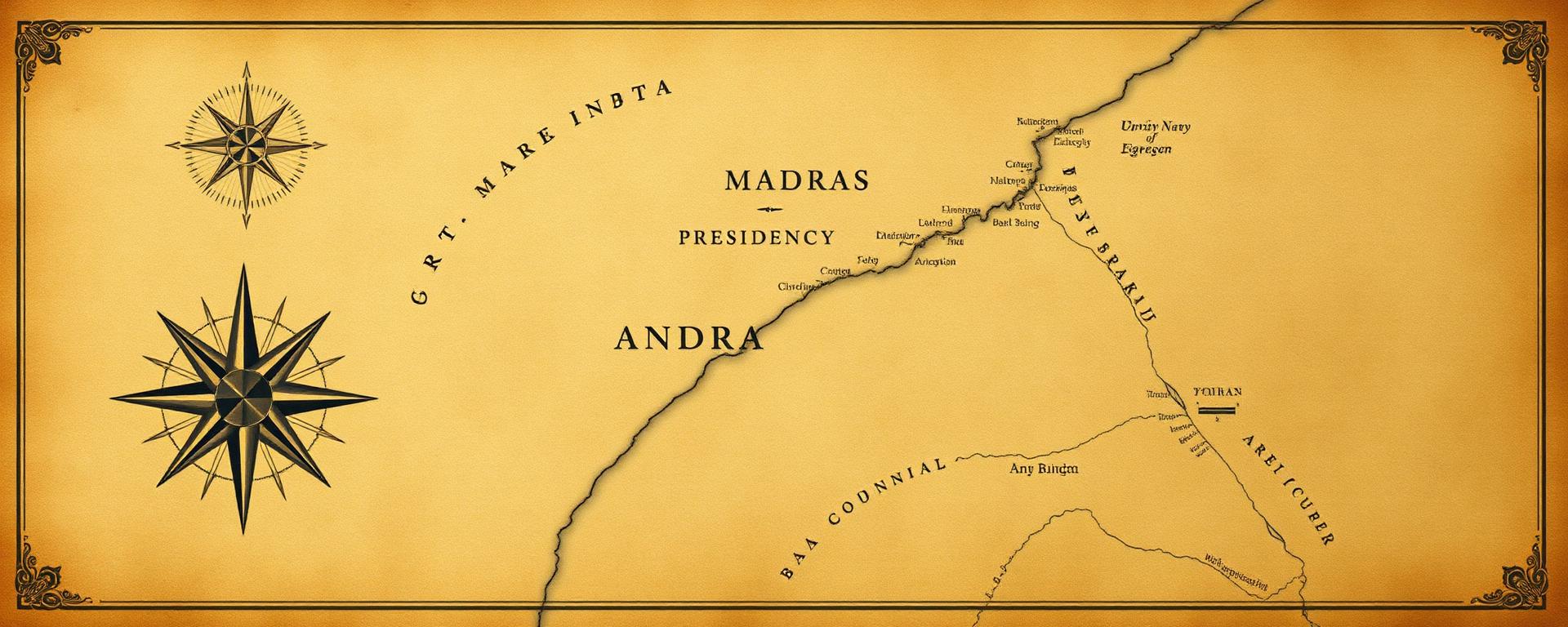
Events Leading to the Formation of Andhra Pradesh State
Understanding how linguistic identity, political movements and public sacrifice led to the creation of Andhra Pradesh.
Constituted formally in 1653 (Fort St George) and reorganised in 1858 after the Crown takeover, the Madras Presidency stretched from Ganjam in the north to Cape Comorin in the south — a multilingual super-province where Telugus were the single largest linguistic group (~40%) yet politically the least represented.
Between 1850 and 1920 a self-conscious 'Andhra' identity crystallised — powered by Telugu literary revival, social reform, journalism and Congress politics. It transformed a linguistic group into a political community demanding its own province.
Nine converging reasons — administrative, linguistic, economic, political, cultural, educational, employment, regional-balance and identity — drove the demand. Each rested on a concrete historical grievance, not abstract sentiment.
The gentlemen's understanding between Coastal Andhra & Rayalaseema
Signed at 'Sri Bagh', the Madras residence of Kasinathuni Nageswara Rao (Andhra Patrika), by leaders of Coastal Andhra and Rayalaseema to reassure the backward Rayalaseema region and preserve unity of the future Telugu state.
Constituted by the Constituent Assembly on 17 June 1948 under Justice S. K. Dar (Allahabad HC) with Panna Lall & Jagat Narain Lal, to examine the desirability of linguistic provinces. Report submitted 10 December 1948.
A three-member Congress committee set up at Jaipur Session (Dec 1948) — Jawaharlal Nehru, Vallabhbhai Patel and Pattabhi Sitaramayya — hence 'JVP'. Report submitted 1 April 1949.
Potti Sreeramulu was Mahatma Gandhi's disciple in Sabarmati Ashram. Gandhi once said, 'If only I had eleven more followers like Sreeramulu, I would win freedom in a year.' Andhra State became India's first state formed on a purely linguistic basis.
Did You Know? — The Sri Bagh house
The Sri Bagh Pact was signed not in Andhra but in Madras city — at the residence of Kasinathuni Nageswara Rao, editor of Andhra Patrika. The house 'Sri Bagh' still stands on Nungambakkam High Road.
Did You Know? — Kurnool for a reason
Kurnool was chosen as capital of Andhra State (1953–56) because of the Sri Bagh Pact of 1937 — the High Court went to Guntur and the capital to Kurnool as Rayalaseema safeguards.
Did You Know? — Swami Sitaram's forgotten fast
Before Potti Sreeramulu, Swami Sitaram undertook a 35-day fast in August 1951 for the Andhra State. He broke it after Nehru's assurances — but the demand kept escalating, culminating in Sreeramulu's 58-day fast the next year.
Did You Know? — The 1953 midnight
On the night of 30 September 1953, the flag of Andhra State was unfurled at Kurnool at exactly midnight — mirroring the 'tryst with destiny' symbolism of 15 August 1947. T. Prakasam took oath at dawn on 1 October 1953.
Did You Know? — The cost
Seven people died in the police firing that followed Potti Sreeramulu's death — the immediate trigger for Nehru's announcement of a separate Andhra State on 19 December 1952.
The Gandhian whose 58-day fast created Andhra State
Born 16 March 1901 in Madras to Telugu parents from Nellore; died 15 December 1952 at Madras after fasting for 58 days demanding a separate Andhra State. India's only martyr for a linguistic state — his death forced Nehru to concede a separate Telugu-speaking province, leading to Andhra State (1953) and the entire linguistic reorganisation of India (1956).
By mid-1952 the JVP concession of 1949 had produced nothing on the ground. Nehru insisted on retaining Madras city, deadlocking the state formation. Swami Sitaram's 35-day fast (Aug 1951) had been broken on Nehru's vague assurances. Sreeramulu declared: 'The Andhras have to accomplish this task, and I will fast unto death.'
India's first state formed purely on a linguistic basis
Carved out of the 11 Telugu-speaking districts of the erstwhile Madras State via the Andhra State Act, 1953. Inaugurated at Kurnool on 1 October 1953; the day is celebrated as 'Andhra State Formation Day'.
Visalandhra achieved — first 'Visala' Telugu state
Andhra State (1953) merged with the Telugu-speaking Telangana region of the erstwhile Hyderabad State via the States Reorganisation Act, 1956, forming Andhra Pradesh — a united homeland for all Telugus. Capital: Hyderabad. First CM: N. Sanjeeva Reddy. This unity lasted 58 years until the 2014 bifurcation.
This cluster (Sreeramulu → Andhra State 1953 → SRC → Gentlemen's Agreement → AP 1956) has produced at least one question in every APPSC Group-2 paper since 2011 — often 2–3 questions per paper. Master the eight highest-frequency facts and you unlock the entire chapter.
Sixty seconds. Read this block on exam morning and you have the entire chapter cached.
Fort St George (1653) → full Presidency (1785) → Crown Province (1858) under a Governor-in-Council with a Legislative Council after 1861.
Governor at the apex • Executive Council • Board of Revenue • District Collectors under 4 divisions (Northern, Central, Southern, Ceded).
Ganjam, Vizagapatam, East & West Godavari, Krishna, Guntur, Nellore, Kurnool, Cuddapah, Anantapur, Chittoor, Bellary — grouped later as 'Coastal Andhra' + 'Rayalaseema' + 'Ceded'.
Telugu ≈ 40%, Tamil ≈ 38%, Malayalam ≈ 11%, Kannada ≈ 8%, others ≈ 3% — Telugus largest yet minority in Madras city itself.
Madras city — Tamil-majority, hub of commerce, education and administration; benefits gravitated southward, away from Telugu districts.
By 1937 the Andhra demand looked achievable, but Rayalaseema (drought-prone, backward) feared domination by the richer Coastal deltas. To preserve unity, top leaders sat down at Sri Bagh.
Coastal: Konda Venkatappayya, B. Pattabhi Sitaramayya, T. Prakasam. Rayalaseema: K. Koti Reddy, H. Sitarama Reddy, P. Ramamurthy Naidu.
Capital and High Court to be located in different regions; Rayalaseema to have first choice for a decade.
Priority for Rayalaseema irrigation projects (Tungabhadra, K.C. Canal) before major coastal works.
A separate university for Rayalaseema (fulfilled later as Sri Venkateswara University, 1954).
Balanced representation in the Assembly and Cabinet berths for Rayalaseema.
Post-Independence, demands for Andhra, Karnataka, Maharashtra & Kerala had intensified; the Constituent Assembly needed a formal review.
Rejected linguistic reorganisation for the time being; urged reorganisation based on administrative convenience, geographical contiguity, financial self-sufficiency and national security.
Threat to national unity, encourages sub-nationalism, delays economic planning, complicates minority protection, unmanageable in the immediate post-Partition mood.
Deep disappointment — mass meetings across Coastal Andhra; press led by Andhra Patrika condemned the report; Andhra Congress passed unanimous resolutions of dissent.
Forced the Congress to appoint the JVP Committee within months — the report became the trigger, not the conclusion, of the debate.
Chair: S. K. Dar • Members: Panna Lall, Jagat Narain Lal • Constituted: 17 June 1948 • Reported: 10 Dec 1948 • Verdict: 'Against linguistic provinces'.
J — Jawaharlal Nehru (PM), V — Vallabhbhai Patel (Home), P — Pattabhi Sitaramayya (Congress President, Andhra).
Set up to review the Dhar report in light of Congress resolutions and rising public demand — particularly in Andhra.
(1) Linguistic reorganisation not desirable at present; (2) Unity, security and economy paramount; (3) BUT if public sentiment is overwhelming, Andhra could be considered as a special case — provided Madras city was not claimed.
Effectively made Andhra the test case; the 'Madras city' condition became the sticking point that delayed the state until 1953.
The report energised the movement — leaders shifted from petitions to satyagraha; Swami Sitaram (1951) and Potti Sreeramulu (1952) fasted for the demand.
Frequently paired with Dhar in match-the-following & 'differentiate between' questions; year (1949), members (JVP) and 'special case for Andhra' clause are must-know.
A multi-lingual British province governing Telugu, Tamil, Kannada & Malayalam regions from Madras city — the frame within which the Andhra grievance was born.
Cultural identity, unequal share of jobs, budget & irrigation projects, and neglect of Rayalaseema fuelled the demand for self-governance.
Telugu — a distinct classical language — became the unifying symbol; linguistic identity replaced caste & region as the political anchor.
Telugu districts complained of low public spending, drought neglect in Rayalaseema and diversion of Krishna–Godavari waters to Tamil areas.
Telugu leaders were under-represented in the Madras cabinet, university and services despite forming ~40% of the population.
The Andhra experience made states genuine partners in the Union — the template still visible in debates on GST Council, inter-state water disputes and finance commissions.
Recognition of Telugu as a Classical Language (2008) and the 2014 Telangana bifurcation both flow from the identity politics first crystallised in 1913–56.
The SR Act 1956 method (commission → parliamentary Act → Article 3) was re-used for Uttarakhand (2000), Chhattisgarh (2000), Jharkhand (2000) and Telangana (2014).
Sri Bagh–style safeguards inspire modern demands for backward-region boards, special-status packages (Rayalaseema, North Coastal, Uttarandhra) and the AP Reorganisation Act's Article 371-D.
AP's three-capital experiment (2020) and demands for zonal boards revive the 1937 principle that political and economic power should not concentrate in one region.
Debates on a new AP capital, Krishna-Godavari water sharing with Telangana, and Rayalaseema development boards are direct descendants of the 1937–56 grievances.
16 March 1901, Madras — family from Padamatipalem, Nellore district.
Sanitary Engineering, Bombay — worked with the Great Indian Peninsular Railway (GIPR).
Wife and newborn died in 1928 — turning point; renounced worldly life and joined Sabarmati Ashram in 1929.
Lived in Sabarmati (1929–36); participated in Salt Satyagraha (1930) and Individual Satyagraha (1940–41); jailed multiple times.
Worked at Gandhi's Harijan Sevak Sangh — fasted 3 times (1946–48) for temple-entry rights of Dalits in Nellore.
19 October 1952 – 15 December 1952 (58 days) at Bulusu Sambamurthy's house, Madras, demanding a separate Andhra State.
Died on the night of 15/16 December 1952; funeral procession of 5+ lakh people; violence erupted; Nehru announced the state on 19 December 1952.
'Amarajeevi' — the Immortal Being; also 'Andhra Bhishma' by admirers.
19 Oct 1952 – 15 Dec 1952 = 58 days.
Bulusu Sambamurthy's house, Royapettah High Road, Madras.
Only water; refused salt, glucose, medicines after Day 40.
Silence for 45 days → belated concessions after death → mass riots forced Nehru's hand.
7 killed, 200+ injured across 4 towns; property loss over ₹1 crore (1952 value).
Nehru announced Andhra State on 19 Dec 1952; state formed 1 Oct 1953 — the immediate demand achieved.
Chain-reaction — SRC set up 1953; SR Act 1956; 14 linguistic states across India by 1960.
1 October 1953 — inaugurated at Kurnool at dawn by Sri Chakravarti Rajagopalachari (invited chief guest).
Andhra State Act, 1953 (Act 30 of 1953) passed by Parliament on 25 March 1953.
Kurnool (as per Sri Bagh Pact 1937 — Rayalaseema's turn for the capital).
Tanguturi Prakasam Pantulu ('Andhra Kesari') — sworn in 1 October 1953.
Chandulal Madhavlal Trivedi — earlier Governor of Punjab.
Located at Guntur (per Sri Bagh Pact) — first Chief Justice: Justice K. Subba Rao.
Unicameral Andhra Legislative Assembly (140 seats) at Kurnool; Speaker: A. Kaleswara Rao.
≈ 2.1 crore across 11 districts, ~1.06 lakh sq km.
Fulfilment of the Telugu linguistic demand — direct outcome of Potti Sreeramulu's martyrdom.
1 November 1956 — celebrated as AP Formation Day / Andhra Pradesh Avataraṇa Divasam.
States Reorganisation Act, 1956 (Act 37 of 1956) — enacted 31 August 1956, effective 1 November.
Hyderabad — chosen over Kurnool because of infrastructure, cosmopolitan character and Telangana's political weight.
Neelam Sanjeeva Reddy — later 6th President of India.
Chandulal Madhavlal Trivedi (continued from Andhra State).
Andhra State (Coastal + Rayalaseema, 11 dists) + Telangana (9 Telugu dists of Hyderabad State).
20 districts at formation (later increased to 23 by 1978).
Bicameral — Legislative Assembly (Vidhan Sabha) + Legislative Council (Vidhan Parishad).
Gentlemen's Agreement (20 Feb 1956) — 14-point safeguard for Telangana.
Hyderabad — between leaders of Andhra State and Telangana region of Hyderabad State.
Andhra: B. Gopala Reddy, N. Sanjeeva Reddy, G. Latchanna, A. Satyanarayana Raju. Telangana: Burgula Ramakrishna Rao, K. V. Ranga Reddy, M. Chenna Reddy, J. V. Narsing Rao.
Reassure Telangana that its interests would be protected in the merged state.
(1) Regional Council for Telangana; (2) Deputy CM from the region NOT of CM; (3) Domicile rules for jobs & education; (4) Surplus Telangana revenue to be spent on Telangana; (5) Cabinet share of 40% for Telangana; (6) 12-year Mulki safeguards.
Political agreement — never given statutory backing, source of later grievance leading to 1969 Telangana agitation and 2014 bifurcation.
Date (20 Feb 1956), signatories, and reason it was 'gentlemen's' (unenforceable) — all high-frequency facts.
Very High
Frequently asked in APPSC Group-1 & Group-2.
Andhra Movement
Understand its causes, phases and personalities.
Visalandhra • SRC • Gentlemen's Agreement
Cluster of high-yield chapters.
Modern Andhra
Base for understanding 1969, 1972 and 2014 events.
Distance & Neglect
Vizag, Ganjam over 800 km from Madras — Collectors ruled remotely; petitions took months.
Tamil & English
Telugu litigants forced to argue in unfamiliar tongues; low conviction of local pleaders.
Unequal Spending
Cauvery-Mettur got large irrigation grants; Krishna-Godavari deltas & Rayalaseema starved of capital.
Madras University Bias
Only 3 Telugu colleges by 1900 vs 12+ Tamil ones; Telugu textbooks scarce.
Under-representation
Telugus held < 20% of gazetted posts in 1911 despite being 40% of population.
Weak Voice
Only 4 of 28 elected members in the 1893 Madras Legislative Council were Telugu — even fewer in the Executive.
Governance from Madras was remote & inefficient.
Example: Vizag Collector's files travelled 800+ km to Fort St George in the 1920s, delaying famine relief.
Telugu had no official status in courts or offices.
Example: Court proceedings at Guntur (1918) conducted in Tamil-English despite Telugu litigants.
Krishna-Godavari & Rayalaseema starved of investment.
Example: Cauvery-Mettur project (1934) sanctioned while Tungabhadra was pending for decades.
Under-representation in Council & Cabinet.
Example: Only 4/28 elected seats in 1893 Madras Council were Telugu.
Telugu literature & arts marginalised in Madras.
Example: Madras University refused Telugu as first language for MA till 1927.
Few colleges, fewer Telugu textbooks.
Example: Andhra University established only in 1926 after decades of demand.
Government jobs cornered by Tamil-Brahmin elite.
Example: 1918 Justice Party report showed Telugus held < 20% of gazetted posts.
Uneven development between Tamil south & Telugu north.
Example: Per-capita revenue spend in Tanjore was almost twice that in Guntur (1921).
Telugus saw themselves as a distinct historical nation.
Example: Publication of 'Andhrula Charitramu' (1911) built a shared historical consciousness.
First intra-Andhra power-sharing accord.
Model for later Gentlemen's Agreement of 1956.
Kurnool became capital of Andhra State (1953); Guntur got the High Court.
Direct fulfilment of the 1937 promise.
Signed at Sri Bagh residence of K. Nageswara Rao.
Not at Vijayawada or Kurnool as often misremembered.
It was not signed between Andhra & Telangana.
Telangana was under Hyderabad State — a different question entirely.
It was not a formal legal treaty.
It was a gentlemen's understanding — morally binding, not legally enforceable.
It did not create the Andhra State.
It only outlined safeguards if & when the state was created.
3 jail terms
Salt Satyagraha, Individual Satyagraha, Quit India.
Dalit Temple Entry
Successful fasts at Nellore temples (1946–48) — rare pre-Constitution victory.
Sabarmati Disciple
One of Gandhi's closest personal followers for 7 years.
58-day fast
Longest recorded political fast unto death in independent India.
Linguistic reorganisation
Directly triggered SRC (1953) and SR Act (1956).
Amarajeevi
The only Indian to earn this title for a state-formation cause.
'If only I had eleven like him…'
Gandhi said this after Sreeramulu's 1946 Nellore temple fast.
Bulusu Sambamurthy's house
Madras — Sambamurthy was ex-Speaker of the Madras Legislative Assembly.
Refused medical intervention
Sreeramulu declined all treatment after Day 40; wanted no compromise.
7 killed, 200+ injured
Police firing in Vijayawada, Anakapalli, Nellore and Vizag on 16–18 Dec 1952.
'Fait accompli by fasting'
Nehru later admitted the decision was forced upon him by public sentiment.
Martyr's Stupa, Chennai
At Royapettah — the exact spot of his fast; annually garlanded on 15 Dec.
Kurnool
Chosen per Sri Bagh Pact — Rayalaseema safeguard.
Guntur
Second Sri Bagh promise — legal capital separate from political.
T. Prakasam
Congress veteran; 'Andhra Kesari' since 1928 Simon Boycott.
C. M. Trivedi
ICS officer, ex-Governor of Punjab.
A. Kaleswara Rao
Andhra Movement veteran.
12 ministers
Balanced between Coastal Andhra & Rayalaseema per Sri Bagh Pact.
Template for linguistic states
Set the precedent for SRC (1953) and SR Act (1956).
First self-governed Telugu polity
After centuries of composite provinces (Vijayanagara → Nizam/Madras).
Kurnool capital + Guntur HC
First tangible fulfilment of Sri Bagh Pact.
Bilingual identity mainstreamed
Made language the primary axis of Indian state politics.
Article 3 activated
First major use of Parliament's power to redraw state boundaries.
Bridge to Andhra Pradesh
Andhra State existed only 3 years — merged with Telangana on 1 Nov 1956.
58 days
19 Oct – 15 Dec 1952. Common trap: '56 days' or '60 days'.
19 Dec 1952
Four days after Sreeramulu's death, not immediately.
1 Oct 1953, Kurnool
First CM T. Prakasam; first Governor C. M. Trivedi.
Fazl Ali
Members: K. M. Panikkar, H. N. Kunzru. Constituted 22 Dec 1953.
20 Feb 1956
Between Andhra & Telangana leaders — 14 provisions.
1 Nov 1956, Hyderabad
First CM N. Sanjeeva Reddy — later President of India.
Nehru–Vallabhbhai–Pattabhi
Not 'Jinnah' or 'Jayaprakash' — a classic distractor.
1937, Madras
Not 1935 or 1939; signed at K. Nageswara Rao's house.
Bapatla — 1st Andhra Mahasabha
President: B. N. Sarma.
Sri Bagh Pact — Madras
Coastal Andhra vs Rayalaseema; K. Nageswara Rao's house.
Dhar Commission — rejects linguistic states
Chair: S. K. Dar.
JVP — special case for Andhra
Nehru + Vallabhbhai + Pattabhi.
Sreeramulu's fast begins
At Bulusu Sambamurthy's house, Madras.
Sreeramulu dies — Day 58
7 killed in police firing next day.
Nehru announces Andhra State
In Parliament.
Andhra State — Kurnool
First CM: T. Prakasam; Governor: C. M. Trivedi.
SRC constituted
Fazl Ali + Panikkar + Kunzru.
Gentlemen's Agreement — Hyderabad
14-point Telangana safeguard.
Andhra Pradesh — Hyderabad
First CM: N. Sanjeeva Reddy.
Act 37 of 1956
Enacted 31 Aug 1956, effective 1 Nov 1956.
Sreeramulu's fast = 58 days
Not 56, not 60. Count 19 Oct → 15 Dec inclusive.
Nehru announced on 19 Dec 1952
Not on 15 Dec (day of death) or 16 Dec (day of riots).
Kurnool = capital of Andhra State only
Never capital of Andhra Pradesh — that was Hyderabad from Day 1.
Sri Bagh ≠ Gentlemen's Agreement
1937 intra-Andhra vs 1956 Andhra–Telangana.
SRC chair = Fazl Ali
Not Panikkar (member) or Nehru (appointer).
JVP does not include Jinnah/Jayaprakash
J = Jawaharlal, V = Vallabhbhai, P = Pattabhi.
First CM of AP = N. Sanjeeva Reddy
T. Prakasam was first CM of Andhra State (1953), not Andhra Pradesh (1956).
Andhra State existed only 3 years
1 Oct 1953 → 31 Oct 1956; merged next day into AP.
1600s–1858
British Rule
East India Company then Crown consolidated south India under one presidency.
1858
Madras Presidency
Telugu, Tamil, Malayalam and Kannada speakers governed as one linguistic mosaic from Fort St George.
Late 19th c.
Telugu-speaking Population
Telugus formed the largest ethnic group but were politically & culturally dominated by Tamils.
Early 20th c.
Administrative Problems
Neglect of coastal Andhra & Rayalaseema — under-representation in jobs, education and irrigation.
1910s
The Language Issue
Tamil dominance in Madras administration, courts and university pushed Telugu identity to the fore.
1913 onward
Demand for Separate Andhra
First Andhra Mahasabha at Bapatla formally raised the demand for a Telugu province.
1852
Telugu Literary Revival Begins
Kandukuri Veeresalingam publishes prose in modern Telugu, founding the Telugu renaissance.
1874
Social Awakening
Veeresalingam launches widow-remarriage movement — first modern Andhra social reform.
1885
Congress & Telugu Elite
P. Ananda Charlu among founding members of INC; Telugu leadership enters national politics.
1892
Educational Movement
Founding of Maharajah's College (Vizianagaram) — early Telugu-medium higher education.
1900
Literary Renaissance Peaks
Gurajada Apparao writes Kanyasulkam — modern Telugu drama with reformist politics.
1906
Vandemataram in Andhra
Bipin Chandra Pal's tour ignites Swadeshi in coastal Andhra — new political awakening.
1910
Andhra Bhasha Samajam
K. Venkatappayya, J. Ramayya Pantulu campaign for Telugu-medium education & separate identity.
1911
'Andhrula Charitramu'
Chilukuri Veerabhadra Rao publishes the first modern Telugu history — creates historical self-image.
1912
Andhra Provincial Conference
Nidadavolu meeting mobilises a formal political demand.
1913
First Andhra Mahasabha (Bapatla)
Presided by B. N. Sarma — the demand for a separate Telugu province becomes official.
1914
Andhra Patrika Daily
Kasinathuni Nageswara Rao's daily becomes the voice of Andhra identity.
1917
APCC Formed
Andhra Provincial Congress Committee — the first linguistic PCC in India.
1920
Nagpur Congress
INC adopts linguistic provinces as an organisational principle — Andhra demand mainstreamed.
1901
Birth in Madras
Born 16 March to a Nellore Telugu family; upbringing steeped in Vaishnavism.
1920s
Engineer in Bombay
Sanitary engineer with GIPR — a comfortable middle-class career.
1928
Personal tragedy
Wife and newborn son die — Sreeramulu turns to Gandhi and public service.
1929
Joins Sabarmati Ashram
Becomes a disciple of Gandhi; adopts austere ashram life for the next seven years.
1930
Salt Satyagraha
Participates in the Dandi march phase — first jail term.
1940–41
Individual Satyagraha
Second jail term during Gandhi's individual civil-disobedience campaign.
1942
Quit India Movement
Third jail term — imprisoned for anti-British activity.
1946
First fast for Dalits
Fasts at Nellore Venugopalaswamy Temple for Harijan entry — succeeds after 10 days.
1948
Fast at Moolapet
Continues temple-entry satyagraha in Telugu districts — deepens social-reform credentials.
1951
Turns to Andhra demand
After Swami Sitaram's 35-day fast fails to move Nehru, Sreeramulu resolves to sacrifice his life for the state.
19 Oct 1952
Fast unto death begins
At the residence of Bulusu Sambamurthy, Madras — demand: separate Telugu state.
15 Dec 1952
Attains martyrdom
Dies on the 58th day; body carried in procession through Madras streets.
19 Dec 1952
Nehru announces Andhra State
Four days after his death — the demand triumphs.
1 Oct 1953
Andhra State formed
India's first linguistic state — his sacrifice validated.
19 Oct 1952
Fast Begins
Sreeramulu starts fast-unto-death at Bulusu Sambamurthy's residence, Mylapore, Madras. Demand: separate Andhra State with Madras as capital.
Days 1–10
Muted Response
National press treats it as a local affair; Congress ignores; Nehru dismisses the demand publicly at a press conference.
Days 11–25
Public Awakening
Andhra Patrika, Andhra Prabha and Krishna Patrika mount campaigns; student unions in Vizag, Guntur and Kakinada begin sympathy fasts.
Days 26–40
Mass Mobilisation
Congress leaders visit; APCC passes resolution supporting the fast; hartals across Coastal Andhra and Rayalaseema; hunger-strike relays begin.
Days 41–55
Health Deteriorates
Doctors report kidney failure; Sreeramulu refuses fluids beyond water; refuses to break fast without a government commitment.
13 Dec 1952
Government Silence
Central government still refuses to commit publicly; Nehru fears setting a precedent for other linguistic demands.
15 Dec 1952 (Day 58)
Death at 11:20 PM
Passes away at Bulusu Sambamurthy's residence. News spreads by radio within hours.
16 Dec 1952
Riots Erupt
Violent protests in Vijayawada, Anakapalli, Vizag, Nellore, Guntur; trains stopped, buses burnt, government property attacked.
16–18 Dec 1952
Police Firing
7 killed and 200+ injured in police firings; Vijayawada worst hit — becomes symbol of state repression.
19 Dec 1952
Nehru Announces Andhra State
In Parliament — 'A separate state for the Telugu-speaking people of Madras Presidency will be formed.'
25 Mar 1953
Andhra State Bill
Passed by Parliament — legislative sanction for the state.
1 Oct 1953
Andhra State Inaugurated
At Kurnool — T. Prakasam sworn in as first CM at dawn. Sreeramulu's sacrifice fulfilled.
1 Oct 1953
Andhra State inaugurated
At Kurnool with T. Prakasam as first CM.
22 Dec 1953
SRC constituted
Fazl Ali (chair), K. M. Panikkar, H. N. Kunzru — to review whole-country reorganisation.
1954
Visalandhra Mahasabha
Movement peaks — Communists and Andhra Congress endorse merger with Telangana.
Sep 1955
SRC Report Submitted
Recommends Visalandhra with safeguards — Telangana treated as an option, not automatic.
20 Feb 1956
Gentlemen's Agreement
Signed at Hyderabad — 14-point safeguard for Telangana.
31 Aug 1956
SR Act enacted
Parliament passes the Act — legal framework for merger.
1 Nov 1956
Andhra Pradesh born
Merger effective; N. Sanjeeva Reddy sworn in as first CM at Hyderabad.
- 1913
First Andhra Mahasabha at Bapatla under the presidency of B. N. Sarma — birth of the linguistic demand.
- 1917
Congress endorses linguistic reorganisation; Telugu-speaking Andhra Provincial Congress Committee formed.
- 1920
Nagpur Session of INC accepts linguistic provinces as a Congress principle.
- 1927
Demand strengthens after Madras Legislative Council debates; All-Parties Conference recommends Andhra.
- 1937
Sri Bagh Pact — Coastal Andhra & Rayalaseema leaders agree on capital, High Court and irrigation safeguards.
- 15 Aug 1947
India gains Independence — new leverage for the Andhra demand within the Union.
- 1948
Dhar Commission recommends against linguistic states, citing risks to unity.
- 1949
JVP Committee (Nehru, Patel, Pattabhi) rejects immediate linguistic reorganisation but leaves door open for Andhra.
- 19 Oct 1952
Potti Sreeramulu begins his fast-unto-death at Madras demanding a separate Andhra State.
- 15 Dec 1952
Death of Potti Sreeramulu after 58 days — riots across Andhra; Nehru announces the state.
- 1 Oct 1953
Formation of Andhra State with capital at Kurnool; T. Prakasam becomes first CM.
- 1 Nov 1956
Formation of Andhra Pradesh — merger of Andhra State with Telangana region of Hyderabad State.
Potti Sreeramulu
Martyr of Andhra
Gandhian; 58-day fast-unto-death (Oct–Dec 1952) forced creation of Andhra State — 'Amarajeevi'.
Tanguturi Prakasam
First CM of Andhra State
'Andhra Kesari'; led the state from Kurnool in 1953.
Konda Venkatappayya
Father of Andhra Movement
Key organiser of the Andhra Mahasabhas since 1913.
Kasinathuni Nageswara Rao
Editor, Andhra Patrika
Host of the Sri Bagh Pact (1937); voice of Andhra identity.
Pattabhi Sitaramayya
Congress President
The 'P' of the JVP Committee; historian of the Congress.
Burgula Ramakrishna Rao
Last CM of Hyderabad State
Signatory of the Gentlemen's Agreement, 1956.
Jawaharlal Nehru
Prime Minister of India
Announced Andhra State on 19 Dec 1952; steered the SR Act, 1956.
N. Sanjeeva Reddy
First CM of Andhra Pradesh
Sworn in on 1 Nov 1956 at Hyderabad.
- He is the single individual who forced the creation of the first linguistic state in India — a national landmark, not just Andhra.
- His dates (19 Oct 1952 – 15 Dec 1952) and the '58 days' figure are classic one-mark prelim traps.
- He connects three high-yield syllabus areas — freedom struggle, social reform (Dalit temple entry) and linguistic reorganisation.
- APPSC has asked about him in 2012, 2014, 2016, 2019 and 2022 — recurring almost every cycle.
- Match-the-following questions frequently pair his name with Bulusu Sambamurthy's house, Amarajeevi title, and Nehru's 19 Dec 1952 announcement.
- Descriptive Group-1 mains often ask: 'Assess the contribution of Potti Sreeramulu to the formation of Andhra State' — a 10-mark essay staple.
- Coastal Andhra (7): Srikakulam, Visakhapatnam, East Godavari, West Godavari, Krishna, Guntur, Nellore.
- Rayalaseema (4): Kurnool, Cuddapah (Kadapa), Anantapur, Chittoor.
- Bellary was initially added but transferred to Karnataka (Mysore State) by the SR Act 1956.
- Ganjam and Koraput (Telugu pockets in Orissa) were NOT included — a long-standing Andhra grievance.
- First Andhra Mahasabha: Bapatla, 1913, presided by B. N. Sarma.
- Sri Bagh Pact: 16 Nov 1937, Madras, K. Nageswara Rao's house.
- Sri Bagh signatories included T. Prakasam, K. Koti Reddy, Pattabhi Sitaramayya.
- Dhar Commission: appointed 17 Jun 1948, reported 10 Dec 1948; rejected linguistic states.
- JVP = Jawaharlal Nehru + Vallabhbhai Patel + Pattabhi Sitaramayya; report 1 Apr 1949.
- Swami Sitaram's fast (Aug 1951) preceded Sreeramulu's — 35 days, unsuccessful.
- Potti Sreeramulu: born 16 Mar 1901, Madras; died 15 Dec 1952 after 58 days.
- Fasting venue: residence of Bulusu Sambamurthy, Mylapore, Madras.
- 7 killed in police firings on 16–18 Dec 1952 across Vijayawada, Vizag, Nellore.
- Nehru announced Andhra State on 19 Dec 1952.
- Andhra State Act: passed 25 Mar 1953, effective 1 Oct 1953.
- Andhra State: 11 districts (7 Coastal + 4 Rayalaseema); capital Kurnool; HC Guntur.
- First CM: Tanguturi Prakasam ('Andhra Kesari'); first Governor: C. M. Trivedi.
- SRC (Fazl Ali, K. M. Panikkar, H. N. Kunzru): 22 Dec 1953 – Sep 1955.
- SRC recommended Visalandhra with Telangana safeguards.
- Gentlemen's Agreement: 20 Feb 1956, Hyderabad, 14 provisions.
- States Reorganisation Act, 1956: Act 37; enacted 31 Aug 1956.
- Andhra Pradesh formed 1 Nov 1956; capital Hyderabad.
- First CM of AP: Neelam Sanjeeva Reddy (later President of India, 1977–82).
- AP was India's first linguistic state formed by merging territories from two prior states.
- Bapatla — First Andhra Mahasabha, 1913.
- Sri Bagh (Madras) — Sri Bagh Pact, 1937.
- Nellore — Sreeramulu's ancestral place; Harijan temple-entry fasts.
- Madras (Bulusu Sambamurthy's house) — 58-day fast, 1952.
- Vijayawada — Epicentre of post-Sreeramulu riots.
- Kurnool — Capital of Andhra State (1953–56).
- Guntur — High Court of Andhra State (1953–56).
- Hyderabad — Capital of Andhra Pradesh from 1 Nov 1956; venue of Gentlemen's Agreement.
| Committee | Year | Purpose | Recommendation | Importance |
|---|---|---|---|---|
| Dhar Commission | 1948 | First to examine linguistic states after Independence. | Rejected linguistic states — cited threat to national unity. | Triggered wider agitation; forced Congress to reconsider. |
| JVP Committee | 1948–49 | Congress panel — Nehru, Patel, Pattabhi Sitaramayya. | Opposed immediate reorganisation but conceded Andhra as a special case. | Opened the door for a Telugu-speaking state. |
| States Reorganisation Commission (SRC) | 1953–1955 | Fazl Ali (chair), K. M. Panikkar, H. N. Kunzru. | Recommended linguistic reorganisation; suggested Andhra + Telangana with safeguards. | Blueprint for SR Act 1956 and formation of AP. |
Swipe horizontally to see more →
| Aspect | Madras Presidency | Andhra State (1953) |
|---|---|---|
| Nature | British colonial multilingual province | Independent India's first linguistic state |
| Capital | Madras city (Fort St George) | Kurnool (per Sri Bagh Pact) |
| Chief Executive | British Governor | Chief Minister (T. Prakasam) |
| Language of Admin. | English & Tamil dominant | Telugu as principal language |
| Territory | Ganjam to Cape Comorin (~1.42 lakh sq mi) | 11 Telugu districts of erstwhile Madras (~1.06 lakh sq km) |
| High Court | Madras HC (1862) | Guntur (until moved to Hyderabad in 1956) |
| Legislature | Madras Legislative Council (multi-lingual) | Andhra Legislative Assembly (Telugu) |
| Represented | Composite south India | Coastal Andhra + Rayalaseema only |
Swipe horizontally to see more →
| Parameter | Dhar Commission (1948) | JVP Committee (1948–49) |
|---|---|---|
| Appointed by | Constituent Assembly | Indian National Congress (Jaipur Session) |
| Composition | S. K. Dar, Panna Lall, Jagat Narain Lal | Nehru, Patel, Pattabhi Sitaramayya |
| Nature | Constitutional / official commission | Party committee |
| Verdict on linguistic states | Rejected — administrative basis preferred | Rejected in general — Andhra as special case |
| Grounds | Unity, security, planning, minorities | Reiterated + political feasibility |
| Impact on Andhra | Provoked mass agitation | Kept the demand alive — 'Madras city' condition delayed it |
| Legacy | Set the terms of debate | Became direct trigger of Andhra State movement |
Swipe horizontally to see more →
| Parameter | Linguistic States | Administrative States |
|---|---|---|
| Basis | Common language & culture | Convenience, geography, revenue |
| Advocates | Congress (post-1920), regional movements | Dhar Commission, early Nehru, some Constituent Assembly members |
| Merit | Cultural cohesion, mass participation, better governance in mother tongue | Balanced size, resource sharing, national integration |
| Demerit | Risk of sub-nationalism, minority anxieties | Weak public identification, artificial boundaries |
| Indian example | Andhra Pradesh (1956), Gujarat/Maharashtra (1960), Punjab (1966) | Bombay Presidency, Central Provinces, UP (initially) |
| Constitutional device | SR Act 1956 & later acts | British-era Presidencies pre-1947 |
Swipe horizontally to see more →
| Parameter | Andhra State (1953) | Andhra Pradesh (1956) |
|---|---|---|
| Date of Formation | 1 October 1953 | 1 November 1956 |
| Legal Basis | Andhra State Act, 1953 | States Reorganisation Act, 1956 |
| Capital | Kurnool (per Sri Bagh Pact) | Hyderabad (better infrastructure) |
| High Court | Guntur | Hyderabad |
| Regions Included | Coastal Andhra + Rayalaseema | Coastal Andhra + Rayalaseema + Telangana |
| Districts | 11 | 20 (at formation) |
| First Chief Minister | T. Prakasam (Andhra Kesari) | N. Sanjeeva Reddy |
| First Governor | C. M. Trivedi | C. M. Trivedi (continued) |
| Legislature | Unicameral | Bicameral |
| Reason for Formation | Linguistic demand + Sreeramulu's sacrifice | SRC recommendation + Visalandhra sentiment |
| Guiding Compact | Sri Bagh Pact (1937) | Gentlemen's Agreement (1956) |
| Political Context | Post-martyrdom, fait accompli | All-India reorganisation, negotiated |
| Population (approx.) | ≈ 2.1 crore | ≈ 3.2 crore |
| Duration | 3 years (1953–1956) | 58 years (1956–2014) |
| Historical Importance | India's first linguistic state | First multi-region Telugu Visalandhra state |
Swipe horizontally to see more →
| Category | Most Important Items | Why It's Asked |
|---|---|---|
| Years | 1913, 1937, 1948, 1949, 1952, 1953, 1956 | Prelim date-matching — appears every paper. |
| Personalities | Potti Sreeramulu, T. Prakasam, N. Sanjeeva Reddy, K. Venkatappayya, K. Nageswara Rao, Fazl Ali, Burgula Ramakrishna Rao | Match-the-following with roles/events. |
| Committees | Dhar (1948), JVP (1949), SRC / Fazl Ali (1953–55) | Descriptive & prelim — chair, members, verdict. |
| Agreements | Sri Bagh Pact (1937), Gentlemen's Agreement (1956) | Frequently confused pair — high-yield distinction. |
| Places | Bapatla, Sri Bagh (Madras), Kurnool, Guntur, Hyderabad | Location-based one-mark questions. |
| Acts | Andhra State Act 1953, SR Act 1956 | Legal basis — mains and prelims both. |
| Concepts | Visalandhra, Linguistic State, Mulki Rules, Regional Council | Conceptual descriptive questions in Group-1 mains. |
Swipe horizontally to see more →
Madras Presidency
Multi-lingual British province.
Language Issue
Telugu identity vs Tamil dominance.
Andhra Movement
Mahasabhas + Congress support.
Public Agitation
Meetings, press, student protests.
Potti Sreeramulu Fast
58-day fast-unto-death, 1952.
Public Protests
Riots after his death; 7 killed in police firing.
Andhra State
1 Oct 1953, capital Kurnool.
States Reorganisation
SRC 1953–55; SR Act 1956.
Andhra Pradesh
Merger with Telangana, 1 Nov 1956.
Andhra State (1953)
11 Telugu districts of Madras merged; Kurnool capital.
SRC Report (1955)
Fazl Ali panel recommends merging Telangana with Andhra to form Visalandhra.
Telangana Anxieties
Fears of Andhra dominance in jobs, land, education.
Gentlemen's Agreement
20 Feb 1956 — 14-point safeguard signed at Hyderabad.
SR Act 1956
Parliament enacts on 31 August 1956; effective 1 November 1956.
Andhra Pradesh Formed
1 Nov 1956, capital Hyderabad, first CM N. Sanjeeva Reddy.
“If only I had eleven more followers like Sreeramulu, I would win freedom in a year.”
Sri Bagh = Coastal Andhra vs Rayalaseema within the future Andhra State. Gentlemen's Agreement = Andhra State vs Telangana at the time of merging into Andhra Pradesh.
Andhra State = 11 Telugu districts of Madras with Kurnool as capital. Andhra Pradesh = Andhra State + Telangana of Hyderabad with Hyderabad as capital.
Presidency = British colonial multilingual province (1858–1947). Madras State = post-1947 successor covering Tamil, Telugu, Malayalam, Kannada areas until 1953 bifurcation; renamed Tamil Nadu in 1969.
Separate Andhra = Telugu districts of Madras only (achieved 1953). Visalandhra = united Telugu state including Telangana (achieved 1956).
Dhar (1948) = rejected linguistic provinces. SRC (1953–55) = accepted them and drew the map that made AP possible.
BSDJPK-AP — the seven milestones
Bapatla → Sri Bagh → Dhar → JVP → Potti → Kurnool → Andhra Pradesh. Chant these seven in order and the entire chapter falls into place.
- Timeline: 1913 (Bapatla) → 1937 (Sri Bagh) → 1948 (Dhar) → 1949 (JVP) → 1952 (Sreeramulu) → 1953 (Andhra State) → 1956 (AP).
- Years: 1913, 1920 (Nagpur), 1937, 1948 (Dhar), 1949 (JVP), 1952, 1953, 1956.
- Personalities: Potti Sreeramulu, T. Prakasam, K. Venkatappayya, K. Nageswara Rao, Pattabhi Sitaramayya, B. R. Rao, Nehru, N. Sanjeeva Reddy.
- Committees: Dhar (1948), JVP (1949), SRC / Fazl Ali (1953–55).
- Agreements: Sri Bagh Pact (1937), Gentlemen's Agreement (1956).
- Places: Bapatla, Sri Bagh (Madras), Kurnool, Guntur, Hyderabad.
First Andhra Mahasabha — year & venue
1-markSri Bagh Pact — parties, venue, year & four provisions
DescriptiveDhar vs JVP vs SRC — chair & recommendation
MatchPotti Sreeramulu — dates of fast & death
DateFormation of Andhra State — date, capital, first CM
PrelimSR Act 1956 — key provisions on Andhra Pradesh
DescriptiveTelugu districts of Madras Presidency — list
Prelim
Andhra State was formed on ______ with ______ as its capital.
Who chaired the States Reorganisation Commission that recommended the formation of Andhra Pradesh?
The Sri Bagh Pact was signed between the leaders of which two regions and in which year?
The JVP Committee stood for ______, ______ and ______.
Recurring across Prelims and Mains — master dates and personalities cold.
Visalandhra Mahasabha
Intellectual movement for a united Telugu state.
States Reorganisation Commission
The Fazl Ali blueprint of 1955.
Gentlemen's Agreement
1956 safeguards for Telangana.
Andhra Movement
The larger linguistic-nationalist current.
Formation of Andhra State (1953)
The first linguistic state of India.
Potti Sreeramulu
The Amarajeevi whose sacrifice created Andhra State.